
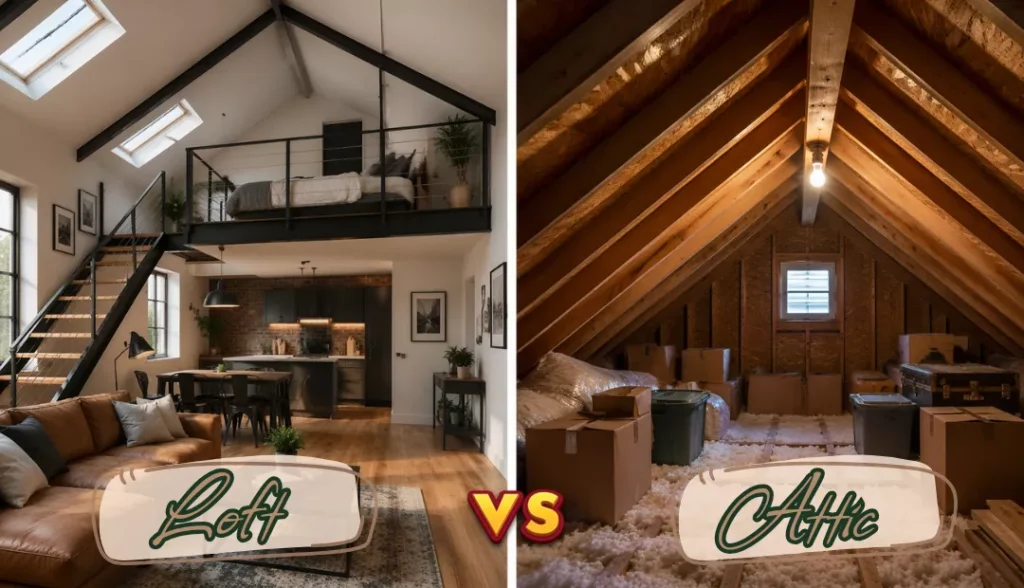
The debate around loft vs attic often leads to confusion. They occupy the same part of a house, so it’s easy to think they’re interchangeable, but they’re not. The difference really comes down to how the space is constructed, how people interact with it and what it’s actually meant for.
This guide provides you with a simple, no-nonsense breakdown so that you can tell the difference and use these terms correctly.
Loft vs Attic: A Quick Comparison
A loft is an upper level in a building, typically overlooking the area below, meant for daily use. It is often found in studios, modern homes or repurposed industrial buildings.
An attic is an enclosed space under the roof of a house. It is typically divided from the main dwelling by a ceiling, entered via a hatch or pull-down ladder and primarily utilized for storage or to contain housing insulation and utilities.
One is built for living, the other built for function.
What Is a Loft?
The term “loft” is derived from the Old Norse word lopt, which originally meant air, sky or an upper room. A loft is high, airy and attached to the rest of the building.
In architecture, a loft is an upper storey or floor that is not separated from the rest of the space it occupies by a full-height wall. Unlike a traditional room, which is separated by walls, a loft looks out over the rest of the home.
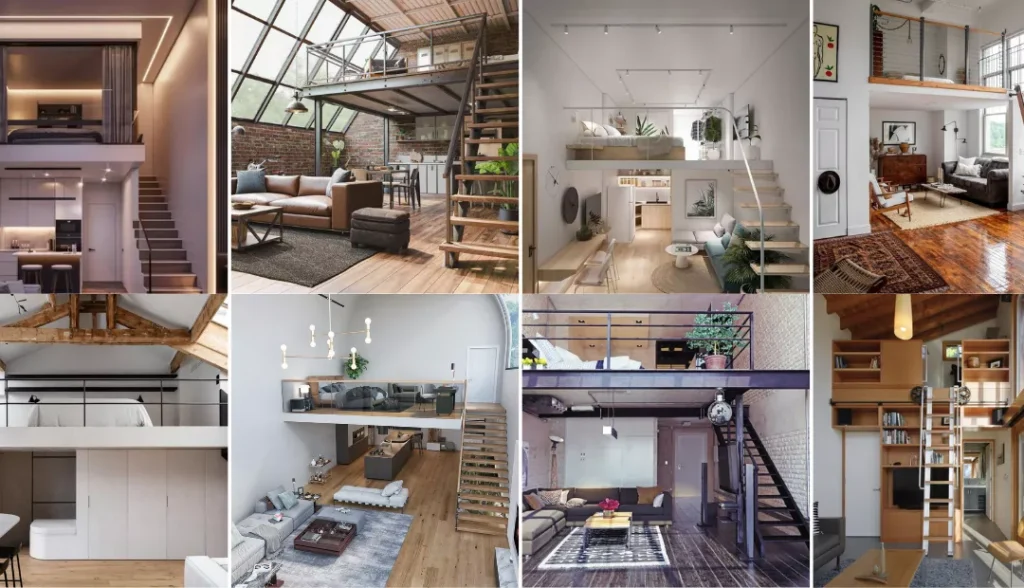
When it comes to residential design, lofts typically manifest in a few standard ways. They are usually big, loft-type apartments in urban areas that were turned into homes from old warehouses or industry buildings. In houses, a loft might be an elevated bedroom or workspace with low walls or railings instead of full partitions.
What Is an Attic?
An attic is a much simpler concept. Specifically, the space above the ceiling of the top floor but below the roof is called an attic.
An attic, unlike a loft, is completely enclosed and structurally separate from the main living areas. It has most commonly served a functional purpose as opposed to a living one. It contains components such as roof trusses, insulation and wiring, and occasionally HVAC systems.
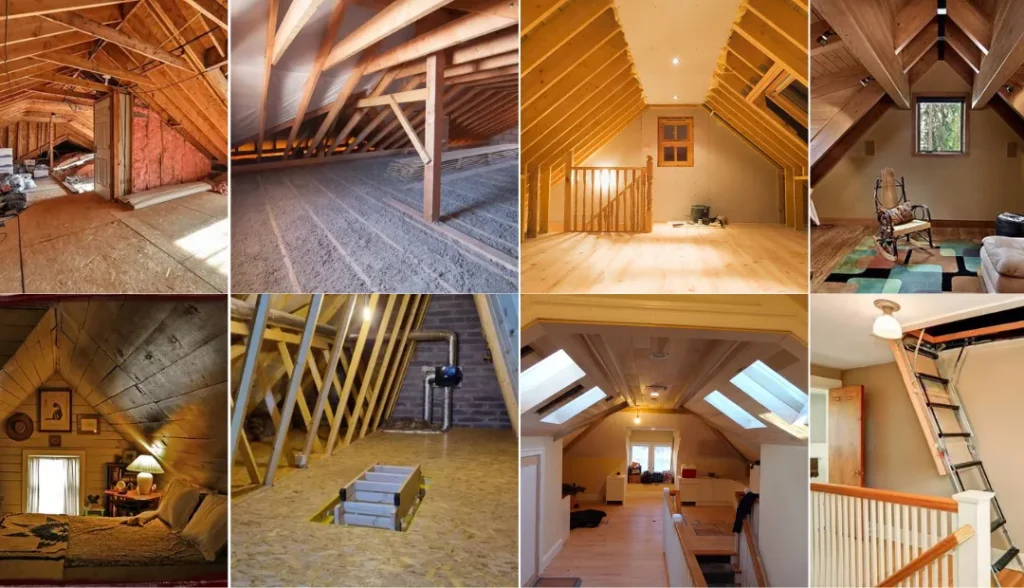
The ceiling height can be more uneven or restricted because the attic follows the shape of the roof. Low clearance and sloping sides also mean it is less comfortable as a living room, unless serious modifications are carried out.
Difference Between Loft and Attic
Structural Point of View
An attic is fully enclosed and has a ceiling separating it from the house below. A loft, though, is open or semi-open; it shares visual and physical connections with the space below.
Different Access
Attics typically provide access through a hatch or pull-down stairs, which restricts the frequency of use. Lofts are intended for frequent access, usually with a proper staircase or fixed ladder.
Ceiling Height
Lofts are designed, in general, to satisfy requirements for habitable space. Attics tend to disappoint on this front because their scale is governed by the angle of the roof, not suitable for human use.
Lighting
Lofts usually have windows or skylights, allowing natural light to enter the room. With limited windows, apart from small vents, attics have very little natural light.
Final Takeaway
A loft and an attic may occupy the exact same vertical zone of a building, but they are designed around entirely different priorities. A loft has openness, accessibility, and a livable ethos. An attic is a closed, confined space designed for storage or structural support.
Once you grasp that distinction, the terms are no longer interchangeable, but they do become useful, especially if you’re contemplating a renovation or assessing a property.
Design smarter spaces with Lines And Volumes.

Dipanjan is a digital marketing professional with five years of hands-on experience across strategy building, content, and performance-driven campaigns. He has worked on building structured marketing systems that focus on reach, engagement, and measurable growth. Known for his analytical thinking and consistency, he brings a practical approach to digital execution. Outside of work, he loves cooking, painting and enjoys exploring interior setups. Connect with him on LinkedIn.