

Ancient Greek architecture developed three main architectural styles, known as Doric, Ionic, and Corinthian. Among these, the Doric order is the oldest and simplest, recognized for its large columns that have vertical grooves (flutes), without a base, simple capitals and friezes that have repeated patterns of metopes and triglyphs.
History of Doric Architecture
The Doric architecture style first appeared in mainland Greece in the 7th century BCE and was mostly used for temples and other important public structures. Over time, the style was adopted by Greek colonies in Southern Italy and Sicily, where it remained popular for many centuries. This architecture is known for its strength, symmetry, and simple design with minimal ornamentation.
Defining Features of Doric Architecture
Massive, Sturdy Columns
Doric columns are thick and wide, which makes them appear stronger and more substantial over the rest of Greek column designs. They were designed to support large buildings as well as the temples and other structures with a solid, sturdy and strong appearance.

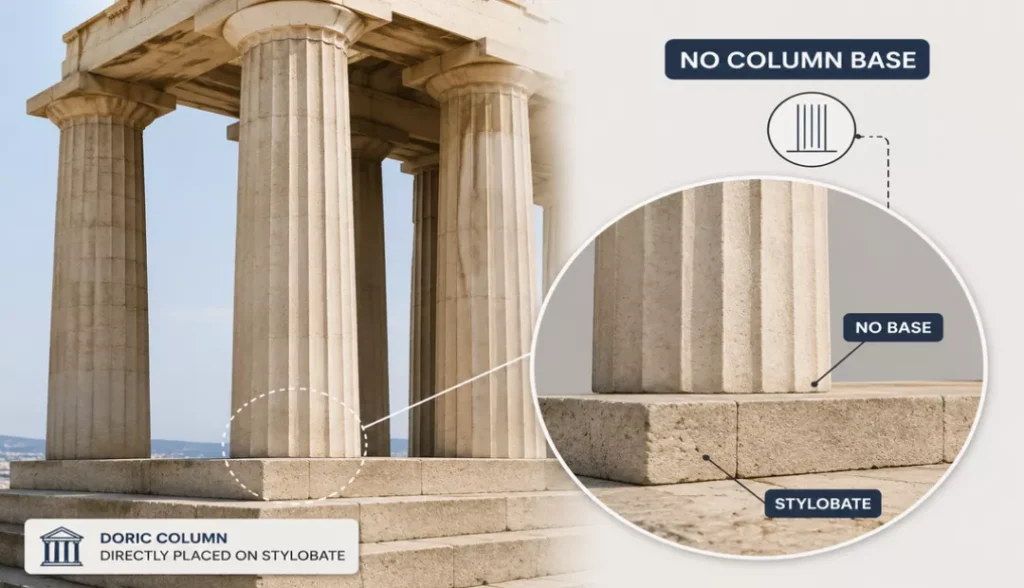
No Column Base
In contrast to Ionic as well as Corinthian columns, Doric columns don’t have the base. Instead, they are placed directly on top of the platforms also known as the stylobate. This simple design provides a solid, plain and sturdy appearance to the Doric columns.
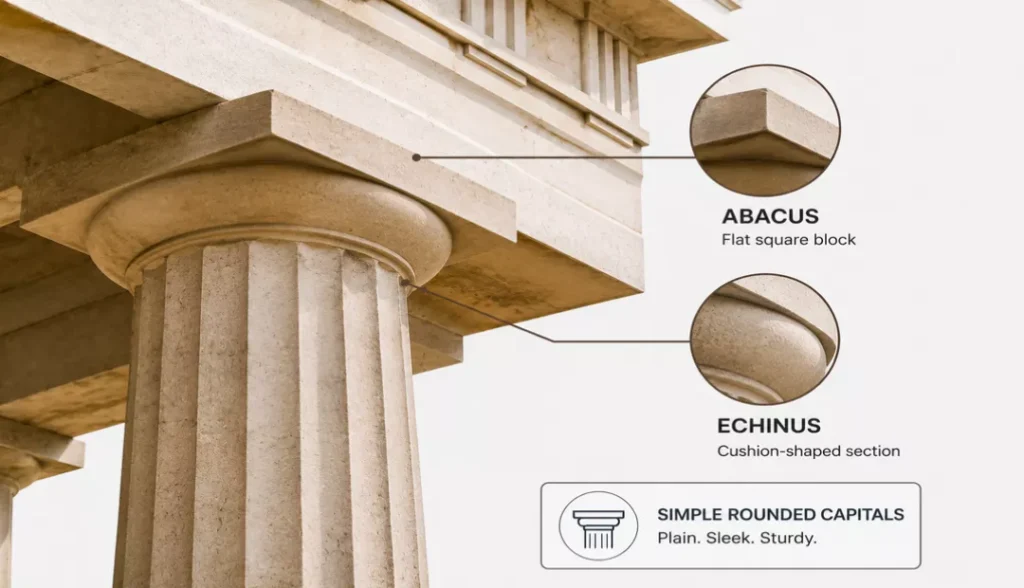
Simple Rounded Capitals
The top of the Doric column is known as the capital, and is composed of two simple components. The first is a cushion-shaped section called the echinus and above it is a flat square block known as the Abacus. These elements have very little ornamental designs, which contribute a plain, sleek, and sturdy appearance.
Fluted Column Shafts
Doric columns generally have 20 vertical grooves known as flutes, that are carved into their surfaces. The grooves create light and shadow effects that add depth and visual interest while maintaining the simplicity of the design.

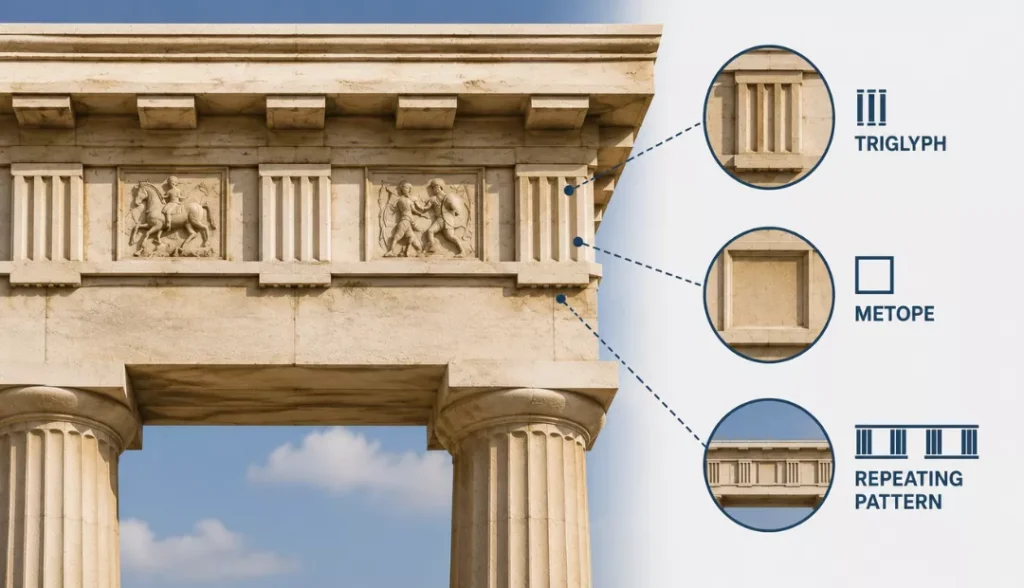
Triglyph and Metope Frieze
Above the columns architrave, Doric frieze has a repeating pattern of triglyphs as well as metopes. Triglyphs are rectangular blocks with three vertical grooves, whereas metopes are square-shaped panels that are either plain or embellished with carvings. This distinctive pattern is one of the defining features of Doric architecture.
Symmetrical Proportions
Doric structures are constructed carefully with planned proportions. The columns’ height, space between them, and the proportions of triglyphs and metopes are calculated to create an aesthetically harmonious and balanced design.

Minimal Decorative Elements
This architecture emphasizes practicality and strength rather than elaborate decoration. Unlike the Ionic style, which has scroll-shaped capitals, or the Corinthian style, which has detailed leaf carvings, the Doric style is plain and simple. Its beauty comes from its balanced proportions and sturdy design, not through intricate ornamentation.

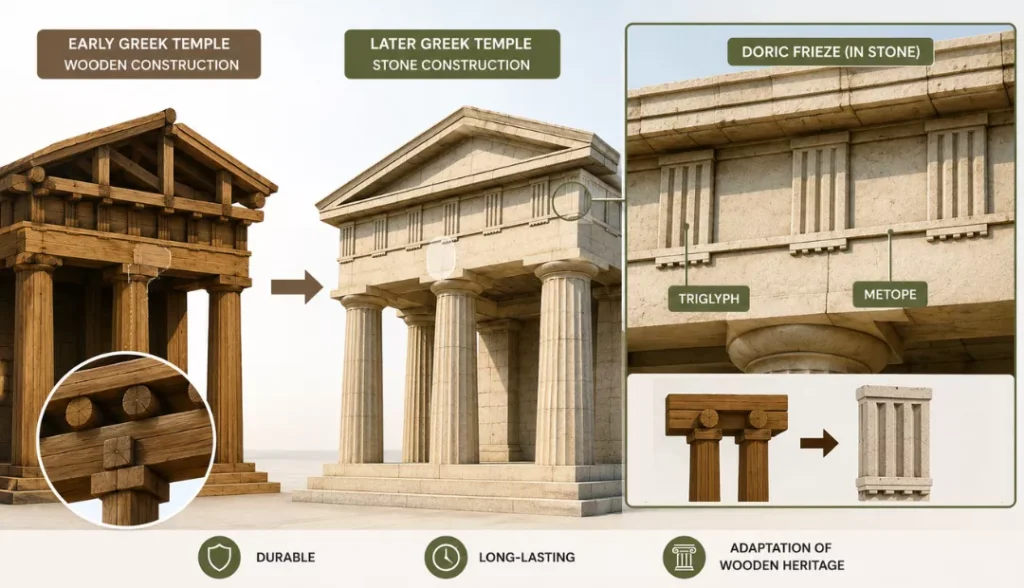
Stone Construction
Early Greek temples were constructed out of wood, however later builders adopted stone since it was more durable and long-lasting. Even after this transition they retained some characteristics of the original wooden temples. For example, triglyphs of Doric architecture are believed to represent the wooden beams although they were later made into stone.
FAQs
How is Doric architecture different from Ionic and Corinthian?
This architecture is characterized by thick columns, no base and simple rounded capitals and a square abacus. These features give a strong, sturdy, and simple appearance.
The Ionic order features slimmer columns, which rest on a base. They also have capitals with a scroll design, referred to as volutes, which makes the appearance more refined.
The Corinthian order is the most decorative ones, featuring tall capitals that are decorated with acanthus leaves as well as intricate designs.
What are some famous Doric architecture located outside of Greece?
This architecture spread across mainland Greece and had a significant impact on Roman and Neoclassical architecture. The famous examples are the Temple of Concordia and the Temple of Hera in Agrigento, Sicily, as well as the temples of Paestum situated in Southern Italy. A number of government structures in Europe as well as in the United States were also designed in the Doric style.
What famous buildings have Doric columns?
The Parthenon located in Athens is the most well-known example of Doric architecture. Other notable examples are The Temple of Hephaestus in Athens as well as the Temple of Concordia. The Lincoln Memorial in Washington, D.C. is inspired by the Doric style. It has solid columns and balanced proportions within the Neoclassical style.
Browse More Architecture Guides:
- 3000 Hanover Lobby in Palo Alto – Form4 Architecture
- Colonial Architecture: History, Characteristics, and Examples
- Javier Senosiain: Types Of Organic Architecture

Navdeep is a PHP programmer by profession, & rider by passion with a strong interest in writing, reflection, and travel. His writing draws from daily experiences across online and real-world settings, often influenced by an interest in interior design and how spaces affect mood and function.