
A roof pitch calculator helps determine your roof’s pitch and the rafter length needed for construction. Enter the roof’s vertical rise and horizontal run, and the calculator will automatically show the roof pitch, slope percentage, and rafter length.
What is Roof Pitch?
Roof pitch describes how steep a roof is by comparing the vertical rise and horizontal run. Roof pitch tells you how much a roof rises vertically for every 12 inches it travels horizontally.
For example: 4:12 roof pitch
means:
- The roof rises 4 inches
- For every 12 inches of horizontal distance
So:
4:12 = 4 inches of rise for 12 inches of run
Similarly:
- 6:12 = rises 6″ for every 12″ horizontally
- 8:12 = rises 8″ for every 12″ horizontally
- 12:12 = rises 12″ for every 12″ horizontally
The higher the first number, the steeper the roof.
What Are Rise and Run?
Rise is simply how high the roof goes up from the wall to the peak.
Run is the horizontal distance over which that rise occurs.
In simple terms:
Rise = vertical height
Run = horizontal distance
Imagine cutting a roof in half and looking at it from the side:
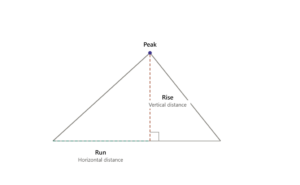
The sloping line represents the roof’s surface or rafter, while the rise and run identify the two straight sides of the triangle.
When to Use a Roof Pitch Calculator
A roof pitch calculator is used when planning a new roof or replacing the existing one. This tool helps to assess the roof pitch and rafter length when reviewing roofing plans. Before finalizing a contractor, you can use it to compare roofing quotes and estimated costs from different contractors.
Keep in mind that the calculator provides an estimate based on the measurements you enter. For complex designs, you may need more precise measurements.
What does the Calculator Actually Calculate?
The calculator takes information such as rise and run and converts it into several different ways of describing the same roof. It also determines the rafter length, which is the length of the sloping line between the rise and run, using the values you enter.
For example, let’s use:
Rise = 6 (in)
Run = 12 (in)
The calculator gives approximately:
Measurement | Result |
Rafter length | 13.4 |
Angle | 26.6° |
Slope/grade (%) | 50% |
Roof pitch | 6:12 |
How Is Roof Pitch Calculated?
Roof pitch is based on the relationship between rise and run.
Now, to find the slope, divide the rise by the run:
Rise ÷ Run
For example, if the rise is 6 inches and the run is 12 inches:
6 ÷ 12 = 0.5
The result, 0.5, represents the decimal slope.
Because roof pitch is commonly expressed using a 12-inch run, a 6-inch rise over a 12-inch run gives a 6:12 roof pitch.
In simple terms:
6:12 means the roof rises 6 inches for every 12 inches of horizontal run.
How does 6:12 become 50%?
This is simple math. To convert roof pitch into a percentage, divide the rise by the run and multiply the result by 100.
Rise ÷ Run × 100
For a 6:12 roof:
6 ÷ 12 × 100 = 50%
So:
6:12 = 50% slope
This means the roof rises 50% of the horizontal distance.
How does 6:12 become 26.6°?
This part may look complicated because it uses trigonometry.
The formula is:
Angle = arctan(Rise ÷ Run)
For a 6:12 roof:
6 ÷ 12 = 0.5
Then:
arctan(0.5) ≈ 26.6°
So:
6:12 pitch angle = approximately 26.6°
This is important because pitch and angle are not the same thing.
Pitch Variations and Unusual Roofs
Not all roofs have the same pitch or shape. For roofs with different pitches or unusual designs, measure the rise and run for each roof section separately. If the sections have different dimensions, their rise and run may also differ.
Example of a Roof With Different Pitch Sections
Suppose a roof has the same rise of 4 ft in each section but different run lengths:
- Section 1: Rise = 4 ft, Run = 12 ft
- Section 2: Rise = 4 ft, Run = 16 ft
For Section 1:
Pitch = (4 ÷ 12) × 12 = 4
So, the pitch is 4:12.
For Section 2:
Pitch = (4 ÷ 16) × 12 = 3
So, the pitch is 3:12.
This example shows that changing the run while keeping the rise the same produces a different roof pitch.
Frequently Asked Questions
What is a roof pitch calculator?
It’s a tool that uses the vertical and horizontal measurements of a roof to calculate its pitch. It can also show the equivalent slope percentage and roof angle.
What should I enter for rise?
Enter the vertical measurement of the roof’s rise. For example, if the roof rises 6 inches over a measured horizontal distance, enter 6 as the rise.
What should I enter for run?
Enter the horizontal distance over which you measured the rise. For example, if the rise is measured over 12 inches horizontally, enter 12 as the run.
Do rise and run need to use the same unit?
Yes. Use the same unit for both measurements. For example, use inches for both rise and run or feet for both.
What does 4:12 roof pitch mean?
A 4:12 pitch means the roof rises 4 inches for every 12 inches of horizontal run. It is equivalent to a 33.3% slope and an angle of approximately 18.4°.
What does 6:12 roof pitch mean?
A 6:12 pitch means the roof rises 6 inches for every 12 inches of horizontal run. It has a 50% slope and an angle of approximately 26.6°.
Can I use a run other than 12 inches?
Yes. You can measure any convenient horizontal distance. The calculator converts the rise-to-run relationship into the standard roof pitch format.
Can I measure roof pitch without climbing onto the roof?
Yes. You can measure the rise and run from inside the attic using a level and tape measure.
Explore more calculators: