
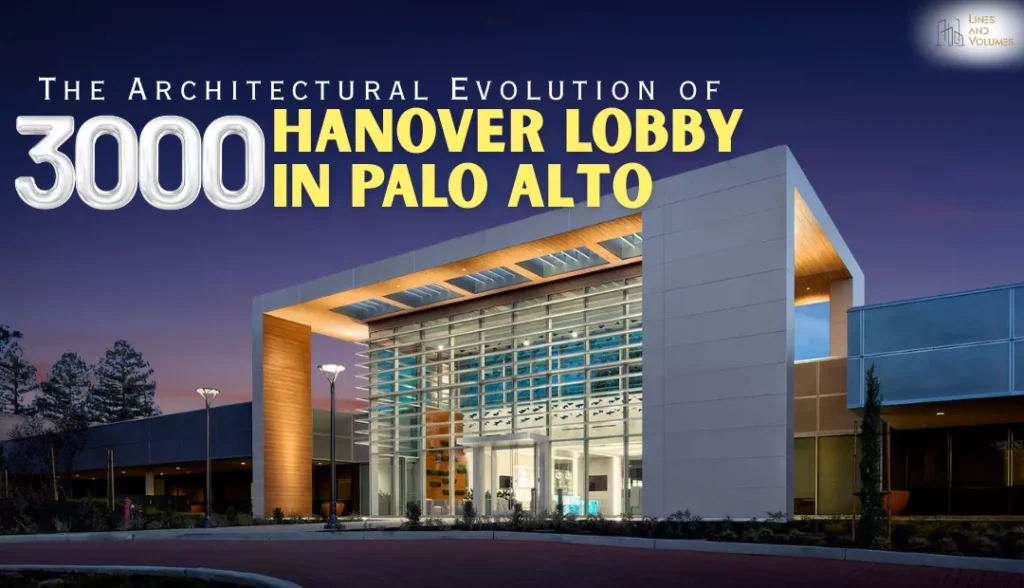
Form 4 Architecture built the 3000 Hanover Lobby in Palo Alto 2022 to convert a former neglected rear entrance of the historic location in the 3000 Hanover Street Campus of a life-science tenant into a new striking entrance of glass and metal. Situated at 3000 Hanover Street, Palo Alto, California 94304, the building features a two-story lobby addition, remodeled signage, improved landscaping, and a changed arrival sequence, all while preserving the building’s historic legacy.
Form4 Architecture designed the project under the leadership of John Marx, AIA. Sand Hill Property Company commissioned the project, who also owns the former Hewlett-Packard headquarters. The building shaped the corporate culture of Silicon Valley after its completion in 1985, also being one of the first buildings to feature the “HP Way.”
This architectural piece functions as both art and design, elegantly supporting the campus’s modern life-science focus while transforming a previously overlooked entrance to the former Hewlett-Packard headquarters.
Project Background & Context
The Building’s History
The 3000 Hanover campus lies within the World’s leading technology and innovation district, the Stanford Research Park. With 500,000 square feet of commercial office space, the campus is known for its striking Brutalist style.
For decades, the structure served as a major headquarters of Hewlett-Packard but beyond its physical presence, the campus became a landmark of the company’s influential management philosophy known as the “HP Way.”
Many of the management practices associated with the “HP Way” were pioneering innovations that helped shape what later became standard corporate management practices throughout Silicon Valley. Some of those management practices include:
- Open-door management
- Flexible working arrangements
- Management by walking around (MBWA)
- Employee empowerment
- Collaborative leadership
HP’s management practices also inspired several contemporary corporate designs in Silicon Valley.
When Sand Hill Property Company acquired the campus, the entire space was strategically repositioned to accommodate two large commercial life science tenants.
A strategic decision was made to invest in adaptive reuse, preserving the campus as a historically significant property while enabling it to accommodate contemporary commercial tenants. The decision also saved the building from demolition.
The Design Challenge
One significant drawback remained despite the prominence of the structure.
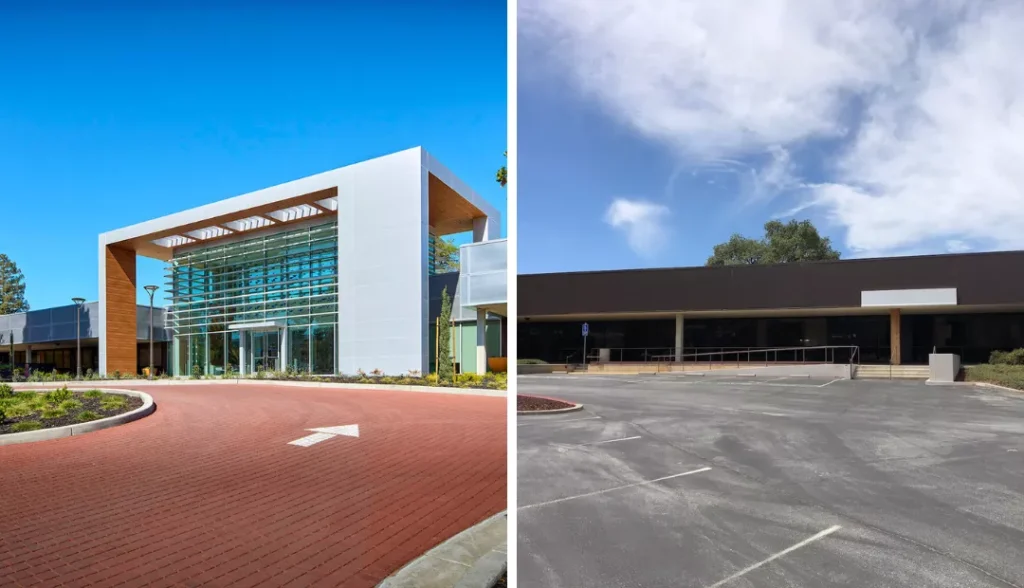
The campus’s rear entrance gives visitors a confusing experience. Visitors arriving from the parking areas encountered a rear entrance that lacked prominence and a sense of arrival, making it an inadequate representation of the campus.
The design challenge issued to Form4 Architecture was to improve rear entrance experience to surpass the primary Hanover Street entrance in visibility, architectural quality, and user experience.
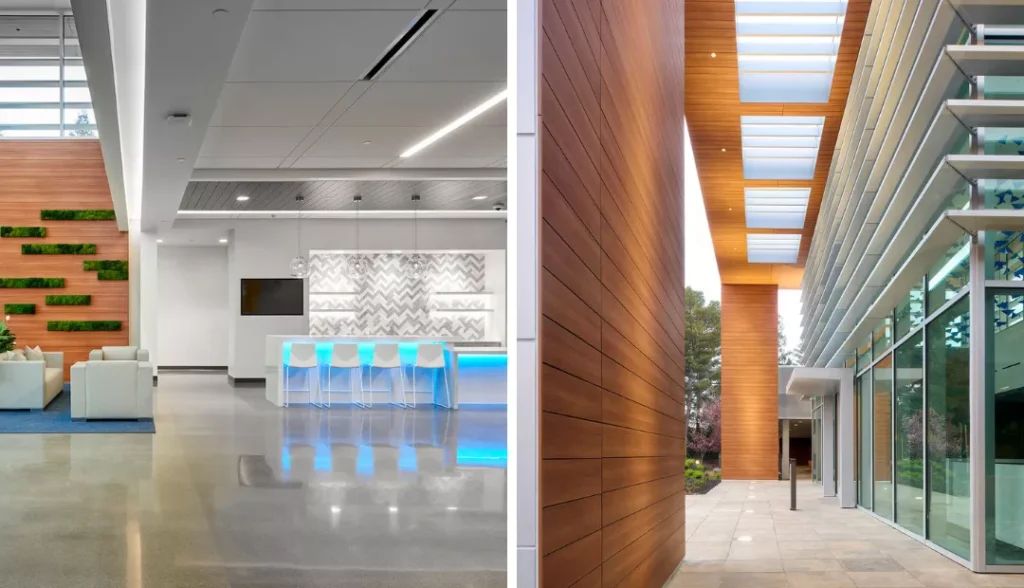
Designers aimed to convert an unappealing back entrance into a space that provides a museum-quality civic experience. Designers wished for this space to act as a destination that, upon arrival, exudes innovation, transparency, and prestige to visitors.
Architectural Design & Key Features
Form & Structure
This project aims to add an approximately 500 square foot, two-story, fully glass lobby addition, which sits on a 2,000 square foot more or less plot of land.
Even with its small footprint, this addition has a large visual impact.
The lobby addition is framed by the addition of a larger architectural structure, which consists of metal panels and warm, wood-look finishes. This framed lobby addition, fully covered in glass, has a visual connection and a clear relationship to the surrounding landscapes.
The lobby addition has clerestory windows on all four sides.
Form4 Architecture calls the addition a “lantern.” The lobby, during the day, has a reflective relationship to the surrounding landscapes and, in the evening, it provides a visual connection for travelers to the center of the campus.
Designers created a striking sense of arrival and identity for the building from a distance by designing a framing architectural element for the addition that is approximately 35 feet tall by 80 feet wide.
Materials & Cladding
Designers were challenged with integrating metal with wood-look finishes into the addition.
The project selects from a careful palette of:
- Alucobond solid panels
- Moz aluminum panels
- Trespa Pura exterior cladding
- High-performance glazing systems
- Metal sun-control louvers
These materials contrast with the brutalism of the original design. They add warmth, and texture, but at the same time, they add depth.
Material selection is interesting because it can show design intent and other decisions and rationality beyond the spirit of design. The construction process could not continue because supply chain disruptions affected projects around the world. The design team finally selected materials with fewer supply chain disruptions, allowing construction to continue.
The result is an exterior design that is responsive and sophisticated.
Approach and Wayfinding
One of the successful aspects of the project is completely rethinking the arrival sequence.
Rather than isolating the lobby as an architectural object, the Form4 design team integrated the path leading visitors take from the parking lot to the entrance.
A colored concrete driveway surface provides a direct route through the site also adding a visual and movement hierarchy.
The sequences of the path includes:
- Visual direction to the lobby
- Enhanced pedestrian flow
- Enhanced accessibility
- Improved campus identity
- Designated drop-off and pick-up zones
This systematic approach to spatial design provides a clear navigation solution to the visitor upon arrival.
The wayfinding design also assists the increasing visitor orientation as the campus transitions from a single-user facility to a multi-tenant life-science focus.
Landscaping
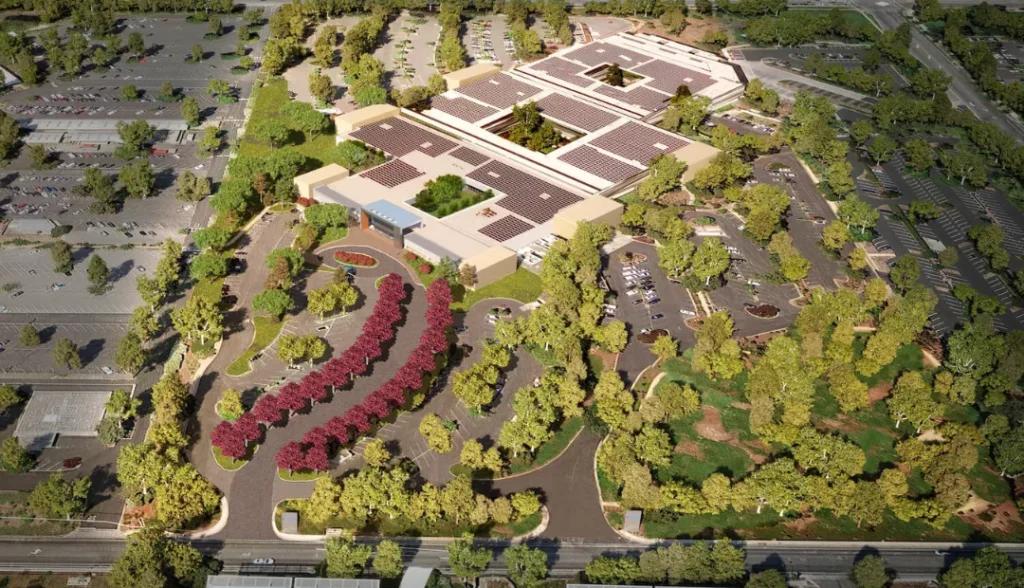
Landscape design and architecture were developed in collaboration with The Guzzardo Partnership, creating an integrated relationship between architecture and site.
The landscaping strategy incorporates layers of planting and soft biophilic design, aptly using trees and native plants to soften the building’s sharp forms.
Dominant elements of the landscape include:
- An expanded tree canopy
- Native and/or adaptive vegetation
- Improved pedestrian pathways
- Gathering spaces
- Visual access to surrounding greens
The design team preserved and complemented the campus’s established and mature character, with special attention to Packard Grove, one of the site’s signature outdoor features.
The collaboration of the landscape and architecture promotes a more inviting place and establishes a sense of the quality of a Silicon Valley workplace.
Location & Campus Context
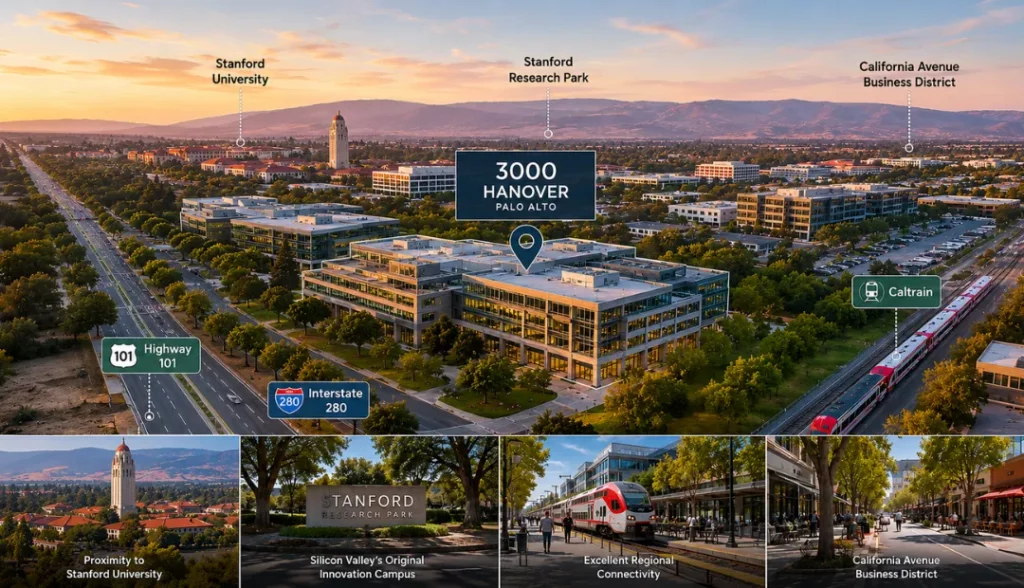
The 3000 Hanover campus is positioned within Stanford Research Park, widely regarded as Silicon Valley’s original and most influential office and research campus. Home to generations of technology pioneers, the research park continues to attract leading companies in technology, biotechnology, and life sciences.
The location offers exceptional regional connectivity, with convenient access to Highway 101, Interstate 280, Caltrain, and the nearby California Avenue Business District. Situated at the 3000 Hanover Lobby in Palo Alto, this accessibility makes the campus attractive to both corporate and research-focused organizations seeking proximity to Stanford University and the broader innovation ecosystem.
Explore More:
- Colonial Architecture: History, Characteristics, and Examples
- El Nido de Quetzalcóatl: Serpent-Shaped Architectural Wonder

Dipanjan is a digital marketing professional with five years of hands-on experience across strategy building, content, and performance-driven campaigns. He has worked on building structured marketing systems that focus on reach, engagement, and measurable growth. Known for his analytical thinking and consistency, he brings a practical approach to digital execution. Outside of work, he loves cooking, painting and enjoys exploring interior setups. Connect with him on LinkedIn.