
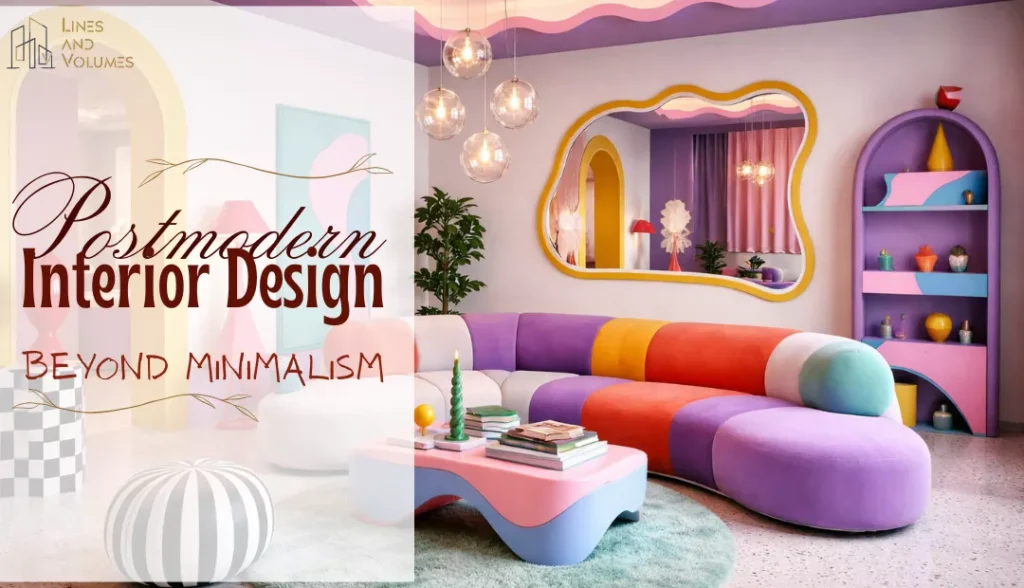
Postmodern interior design is a late twentieth-century style characterized by eclecticism, irony and bold color, which rejects informed modern design rules. Between the 1970s and 1990s, it moved beyond minimal, purely functional design, mixing bold styles and materials with historic references to create expressive, highly personalized interiors with a slightly offbeat feel.
Postmodern interior design emerged as a response to the rigid functionalism of the modernist movement.
From Modernism to Postmodernism — 1960s–70s
Modernism had come to dominate by the mid-20th century. Those interiors (in homes and public spaces) once shaped by clean lines, neutral palettes, and the notion that “form follows function?” Although this half-worked it became a bit boring and limiting.
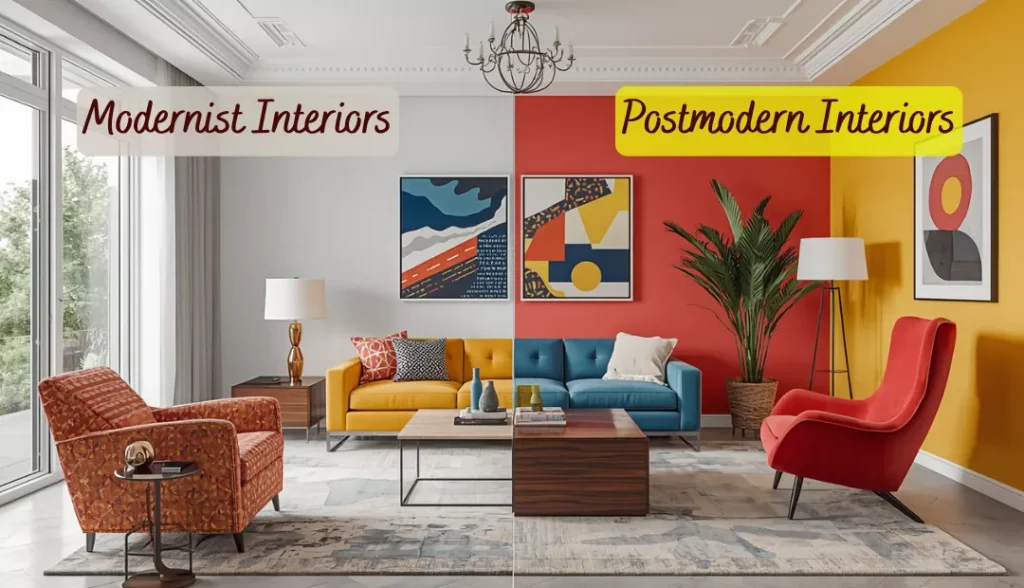
It is a push-back that designers of the 1960s and 70s began to muster. They wondered why spaces had to be so serious, so minimalist, and so uniform. This resistance morphed into a school of thought known as postmodernism. In its place, it has brought about confusion rather than understanding, over-embellishment in lieu of moderation and character to replace consistency.
This change was not only reflected visually. It was a reflection of broader cultural shifts away from rigidity, even if often ironically: an environment embracing individualism and creativity instead of rigid structures. Gone were the days of interiors as solely functional environments. They turned them into an expression medium.
Key Figures and Movements
Postmodern interior design did not just crop up out of nowhere. A pack of designers and thinkers who, rather than retreating to embrace a clean, modernist agenda in the name of practicality, went all-out assault against the tenets of modernism.
Notably, the Memphis Group, which initiated in 1981, best-known for their movements they carried out. Characterized by the use of vibrant colors, mixed geometric patterns, and creative materials, it became synonymous with the visual language of postmodern interiors.
Architect and theorist Robert Venturi suggested that complexity and contradiction were the hallmarks of design, turning modernism on its head with its minimalism.
Michael Graves and Ettore Sottsass melted these concepts into the objects we use every day and interiors in a way that fused function with fun, whimsy, and meaning.
1960s roots -> 1980s peak -> 1990s decline -> present resurgence
Key Characteristics of Postmodern Interior Design
Eclecticism and Rule-breaking
Contrast defines postmodern interiors. They take bits of many styles, and eras, and design languages instead of adhering to just one style.
For example, next to the table in futurism can be a chair in classic. You can mix vintage decor and modern lighting. These combinations are intentional. It’s not about harmony (at least in the traditional sense) but visual interest and tension.
Bright Colors & Patterns
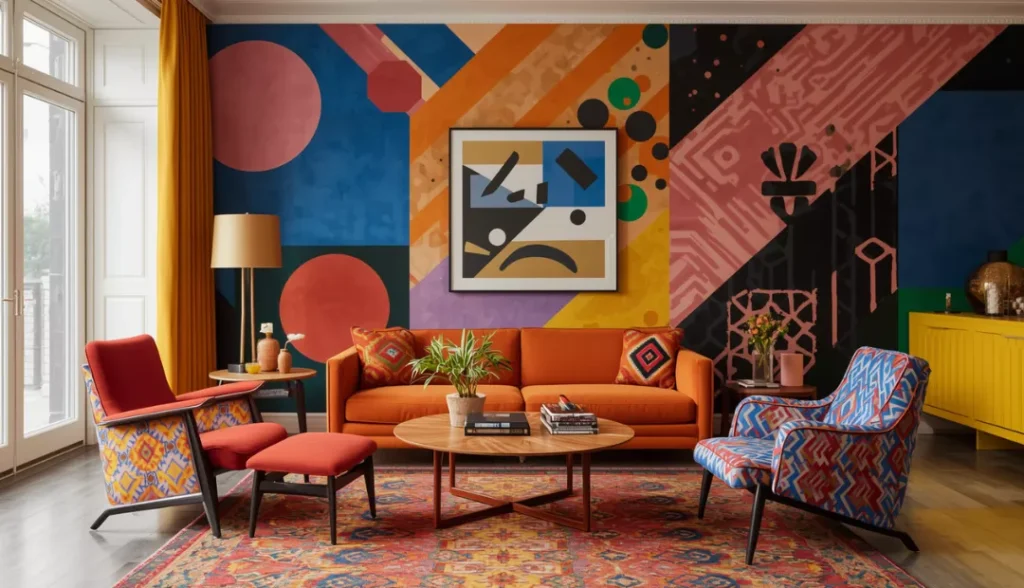
Color is one of the main subjects in postmodern design. Neutral palettes give way to bright, saturated tones. The reds and blues and yellows, even the neons are often presented side by side.
Patterns are equally important. Patterns like geometric designs and abstract motifs along with layered textures combine to create a lively instead of quaint style. Matching is not required. In fact, contrast is preferred.
Irony, Humor and Ornamentation
Postmodern interiors aren’t known for being serious. They contain playful or ironic aspects that interrogate the very notion of “good design.”
Pleas for ornamentation return, although not in a classical sense. Exaggerated, stylized, or used in an unexpected way Commonplace things can take on an artistic or humorous shape, making the utilitarian objects conversation pieces.
Historical and Cultural References
Opposite to modernism, which avoids historical references, postmodern design embraces them.
Columns, arches and Art Deco details might emerge, but not from their original context. As they re-interpreted, or scaled differently or mixed with an unrelated style. This gives it a very layered, collage-type feel.
Mixed Materials Laminate, chrome, marble and plastic
Another defining feature found is contrast in materials. Combines high end and everyday materials.
You may find prissy marble paired with sticky plastic, chrome against lumber. The blend dispels hierarchies, adding layers to the design.
Asymmetry and Unexpected proportions
Postmodern interiors often reject symmetry. Furniture has oversized proportions or unusual shapes.
Instead of strictly functional, tables, chairs, and lighting fixtures come off as sculptural.
Postmodern vs. related styles
Surrounding styles often confused with postmodern design will make understanding what is post modern style easier.
Postmodern vs. Modern
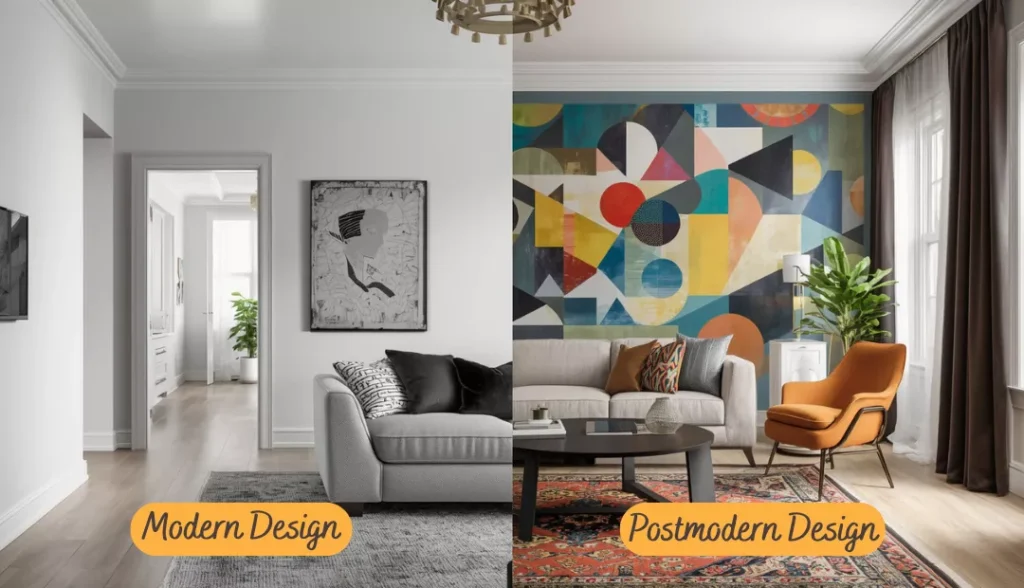
The modern design emphasizes simplicity, clarity and function. The style stays away from overdoing decoration and sticks to neutral tones.
Postmodern design goes in the reverse direction. It accepts complexity, ornamentation and contradiction. When modern design strives for order, post-modern design embraces the notion of controlled chaos.
Postmodern vs. Contemporary
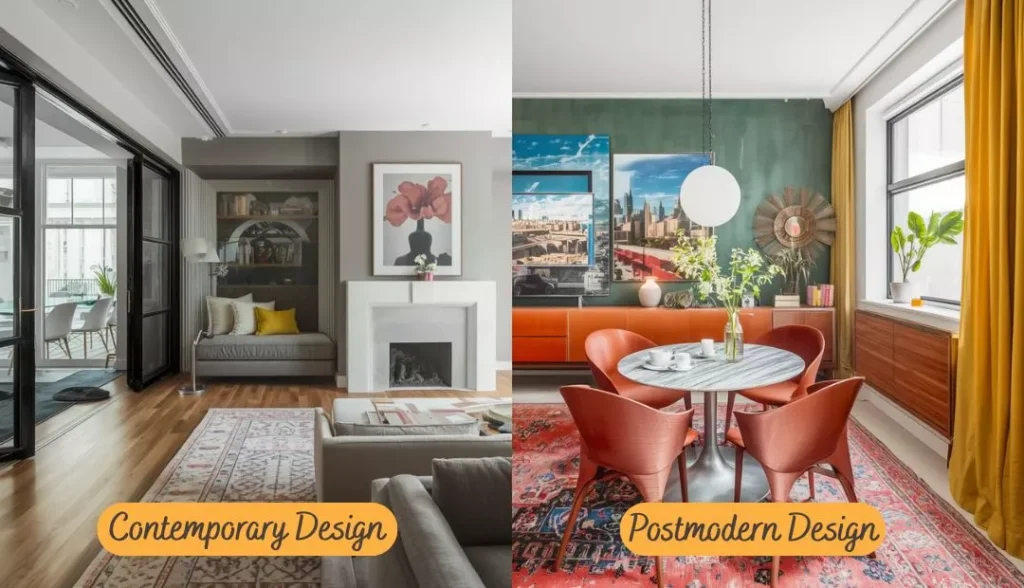
Current contemporary design is what is currently evolving. Postmodern design, however, is associated with a movement of its own time in history. It’s more playful in its experimentation and less assayed. Contemporary spaces often include a touch of postmodernism, but tend to be much more sophisticated.
Postmodern vs. Maximalism
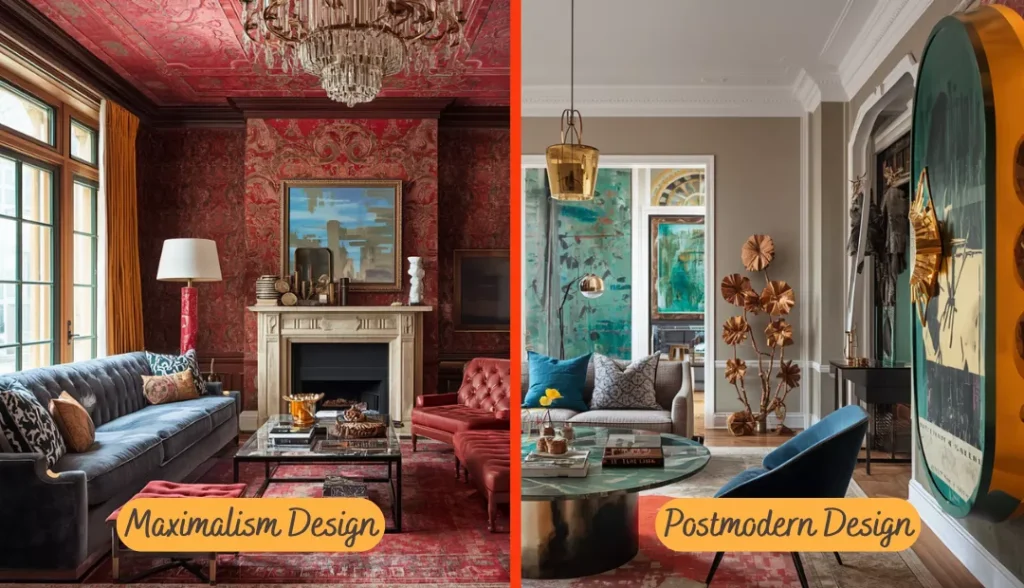
A similar aesthetic connects maximalism and postmodern design through boldness and layering.
Maximalism focuses on abundance, using contrast, irony, and cultural references with intention rather than simply increasing quantity.
In contrast to maximalism’s focus on quantity, postmodernism emphasizes meaning through contrast.
Wrapping Up
Postmodern interior design attracts the audience that prefers freedom over rules. This gives you the opportunity to mix styles, experiment with the best color combinations and create a space that has personality and not pre-defined predictability. For the very few occasions when postmodern design goes beyond the chaotic. It has layers, thoughtfulness and is deliberate. It transforms interiors into a form of personality, creativity and cultural awareness.
Related Reads:
- 7 White Kitchen Blue Island Ideas
- What Is Transitional Style Interior Design
- What Is Trending in Biophilic Interior Design in 2026

Mansi is a creative designer with three years of professional experience, specializing in clean, balanced, and purpose-driven visuals. She is also a passionate writer whose work shows a strong sense of layout, composition, and visual hierarchy. Outside work, she enjoys sketching, experimenting with color, and spending time around plants and outdoor spaces. Connect with her on LinkedIn.