
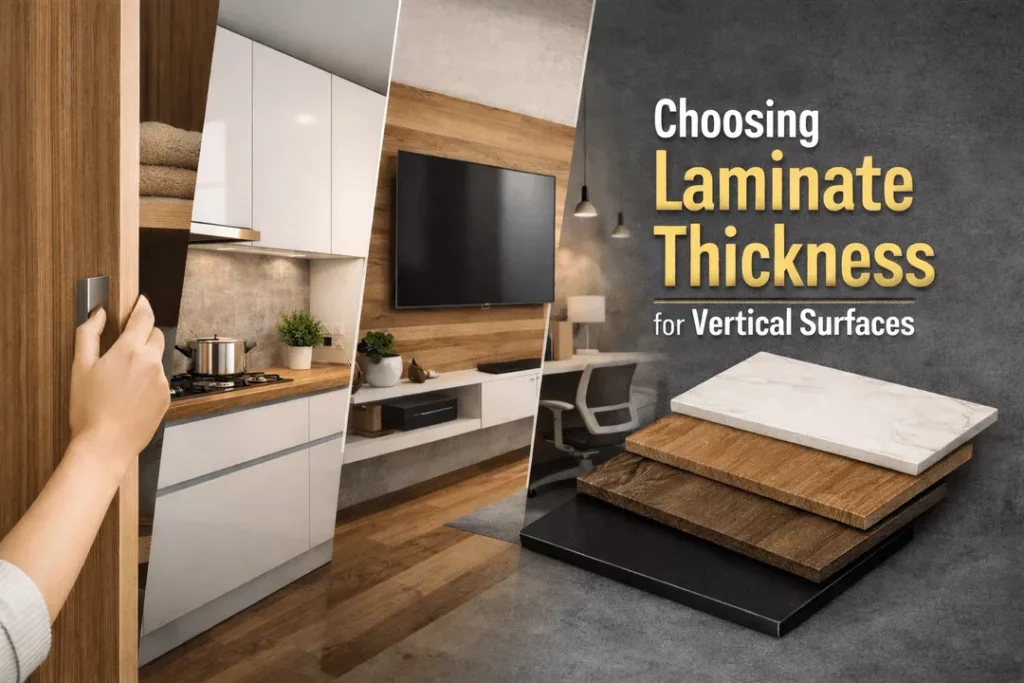
When people talk about laminates thickness, they mainly mean flooring, but laminates used for vertical applications behave very differently.
Decorative laminates used for furniture and wall panels are governed by NEMA/EN grades, they define impact resistance, flexural strength, and intended application grade.
So a laminate used on a wardrobe shutter is not the same product as laminate flooring, even if both are commonly grouped under the word “laminate.”
Don’t simply copy flooring thickness rules, it will cost you unnecessarily.
By understanding this guide you’ll know how to choose laminate thickness for vertical surfaces application and how to choose one logically.
Step 1 — Not Just Thickness
Once laminate grades are clear, choosing the right thickness for each application becomes easy.
| Grade | Typical Thickness | Intended Use |
| Vertical Grade (VGS/VGP) | 0.5–0.7 mm | Panels, shutters, cladding |
| Horizontal Grade (HGS/HGP) | 0.8–1.2 mm | Work surfaces, counters |
| Postforming Grade | ~0.7–0.9 mm | Curved edges |
| Compact Laminate | 3–12 mm | Self-supporting panels |
Key takeaway:
Laminate thickness varies because stress conditions vary. Vertical grade laminates are engineered thinner since they are not designed to resist heavy impact.
Step 2 — Thickness selection by application
Its important laminate thickness must be compatible with substrate stability. Thicker laminates require dimensionally stable cores such as MDF or HDHMR.
1. Wardrobe shutters
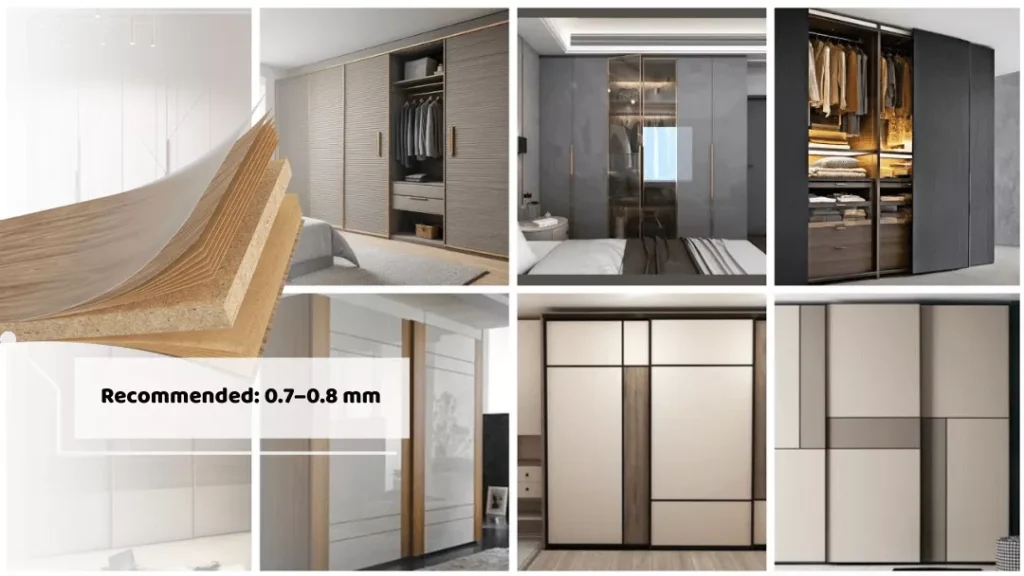
Reason
- Large panels flex when opened. You need flexibility, not rigidity.
Too thick for edge lifting near hinges
2. Kitchen shutters
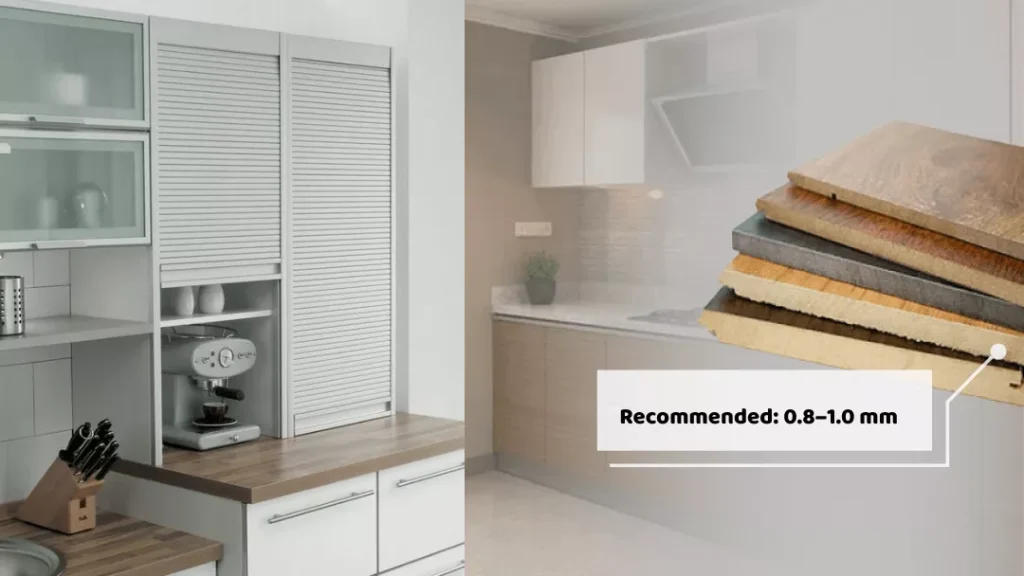
Reason
- High hand contact + grease cleaning + corner knocks
This is wear-driven, not movement-driven.
3. Wall panels / TV panels
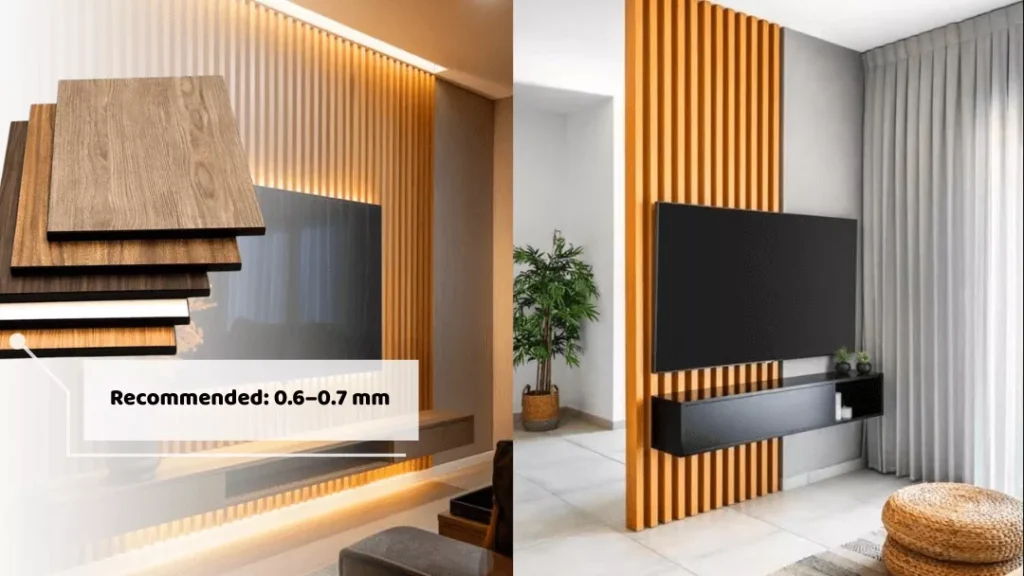
Reason
- No impact load
- Only dimensional stability needed
Using 1 mm here is pure overspecification.
4. Commercial interiors
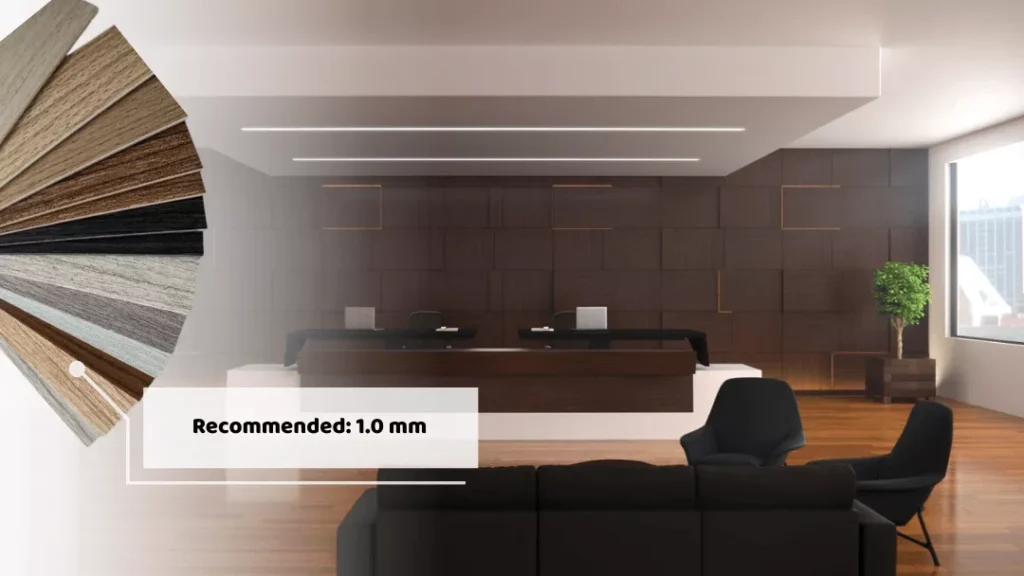
Reason
- Repeated impact from bags, chairs, public usage
Step 3 — Edge rule (the most reliable rule)
Simplifying further more for all specifications:
- If people hit it or frequently touch the laminate, use a thicker one.
- If panels only move then opt thinner.
The real takeaway
When we talk about vertical laminate, it’s not about thickness upgrading quality. Instead, focusing on flexibility matching leads to long-term durability.
Don’t Miss This:

Rahul works in digital advertising with a focus on performance-oriented campaigns and audience targeting. His experience spans campaign planning, execution, and optimization, with an emphasis on efficiency and clarity. Outside of work, he loves playing cricket and enjoys tending to plants and taking long drives. Connect with him on LinkedIn.